
The Professional Guide to Commercial Sound Masking
1. Introduction
Anyone who has worked in an open office knows how distracting nearby conversations can be. A phone call across the room, a private discussion outside a conference room, or constant chatter between workstations can quickly break concentration.
As commercial AV and low voltage integrators, we often hear from business owners, IT teams, and facility managers looking for ways to improve noisy and distracting workplaces. Many initially ask about noise cancellation or soundproofing. In some cases, however, one of the most practical and cost effective solutions is to add carefully controlled sound to the space.
This is the purpose of commercial sound masking.
2. What Is Sound Masking?
A sound masking system is a distributed audio system that introduces a specially designed background sound throughout a space.
The goal is not to make the office louder. Instead, the system gently raises the existing background sound level so that nearby conversations and other distractions are less noticeable.
When the system is designed and tuned correctly, conversations become harder to understand from a distance and naturally fade into the background.
3. How Does Sound Masking Work?
Sound masking works by reducing the difference between speech and the surrounding background sound.
In a very quiet office, even a soft conversation may be easy to understand. Once an engineered background sound is introduced, the words become less clear to people who are not part of the conversation.
When the brain can no longer easily understand the words, it is less likely to focus on them. This can help reduce distractions and improve speech privacy throughout the workplace.
4. Sound Masking Compared With Other Acoustic Solutions
Sound masking is often confused with other forms of acoustic treatment, but each one serves a different purpose.
White Noise
White noise contains equal energy across a wide range of frequencies. It can sound sharp, harsh, or similar to static.
A properly tuned sound masking system uses a more comfortable sound profile that is designed around the frequencies of human speech. When installed correctly, it should blend into the environment and sound more like gentle airflow.
Soundproofing and Acoustic Panels
Soundproofing is designed to stop sound from traveling through walls, ceilings, doors, and other building surfaces.
Acoustic panels reduce echoes and sound reflections within a room.
Sound masking does not block or absorb sound. It makes speech and distractions less noticeable by increasing the background sound level in a controlled way.
Noise Cancellation
Noise cancelling headphones use electronic processing to reduce certain sounds around the listener.
Sound masking works differently. It introduces a consistent background sound throughout a larger area, such as an office, hallway, or waiting room.
5. Key Benefits
A properly designed sound masking system can provide several benefits.
It can improve speech privacy, reduce distractions, and create a more comfortable working environment. It may also help a large or quiet office feel less exposed and less sterile.
The best systems are subtle. Employees should not feel as though they are listening to a speaker system. The sound should blend naturally into the room.
6. Common Applications
Sound masking can be useful in many commercial environments, including:
Open offices where conversations travel between workstations
Healthcare facilities where patient discussions require additional privacy
Law firms, human resources departments, and executive offices where sensitive conversations take place
Corporate boardrooms and conference room areas
Call centers where many conversations happen at the same time
Reception areas, waiting rooms, and shared corridors
7. Five Installation Best Practices
A successful sound masking installation begins with proper planning. Before running cable or placing speakers, the integrator should review the layout, ceiling conditions, room finishes, and privacy goals.
Improve the Acoustics First
Sound masking should not be used to cover up serious architectural problems.
Poor wall construction, highly reflective glass, low partitions, and hard surfaces can all make privacy issues worse. Acoustic ceiling tiles, proper wall construction, and sound absorbing materials may still be necessary.
Sound masking works best when it is part of a complete acoustic strategy.
Mask the Listener, Not the Conversation
When the goal is to improve privacy around a conference room, placing speakers inside the room may cause occupants to talk louder.
A better approach is often to place masking sound in the nearby hallway, open office, or surrounding area. This makes the conversation less understandable to people outside the room.
Create Consistent Coverage
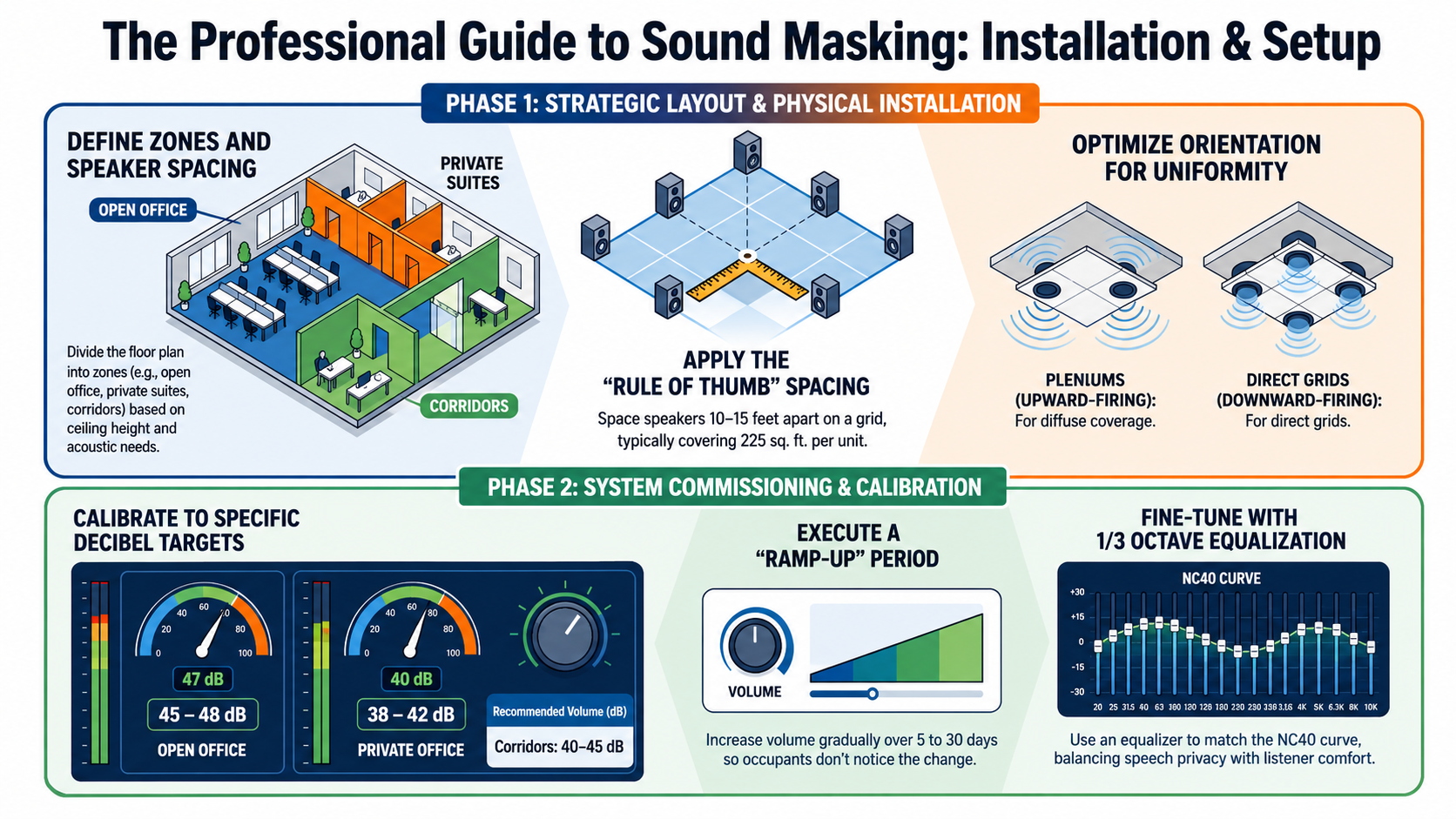
Speakers must be placed carefully so the masking sound is even throughout the space.
Poor placement can create loud areas, quiet areas, or noticeable changes as someone walks across the office. Proper overlap between speakers helps create a smooth and consistent sound field.
Speaker spacing should be based on the ceiling height, plenum conditions, speaker type, and manufacturer recommendations.
Use Smaller Adjustment Zones
Every area of an office sounds different.
Ceiling height, furniture, flooring, walls, and room size can all affect the final result. Smaller control zones allow the technician to adjust specific areas without changing the entire system.
This is especially important when one zone includes open workstations while another includes private offices, corridors, or reception areas.
Increase the Volume Gradually
Turning the system on at full volume can create immediate complaints from employees.
A better approach is to activate the system at a lower level and gradually increase it over several days. This allows occupants to adjust naturally without noticing a sudden change in the environment.
8. Common Mistakes to Avoid
Leaving Volume Controls Accessible
Sound masking controls should not be treated like a shared office thermostat.
When employees can adjust the volume themselves, the system may become too loud in one area and too low in another. Controls should be secured and managed by authorized staff or the integrator.
Ignoring HVAC and Other Building Systems
Heating and cooling systems contribute to the normal background sound of a workplace.
The sound masking system should be tuned while the HVAC system is operating under normal daytime conditions. Otherwise, the final sound level may change significantly once the building is fully occupied and running.
Sound masking should also be coordinated with paging, background music, fire alarm, electrical, ceiling, and other low voltage systems.
Using Masking Speakers for the Wrong Purpose
Some sound masking systems may support paging or music, but that does not always mean they are the best choice for those applications.
For example, speakers aimed upward into a ceiling space may work well for masking but may make music or announcements sound distant and unclear. Dedicated speakers may provide better results for paging and background music.
Failing to Recalibrate the System
Office layouts change over time.
Removing cubicles, replacing carpet, adding glass walls, changing ceilings, or moving furniture can affect the acoustics of the room. The system should be tested and adjusted after major renovations or layout changes.
9. Why Professional Tuning Matters
Installing the speakers is only part of the job.
A sound masking system must also be tested, balanced, and commissioned. The integrator should measure the sound level throughout the space and adjust both volume and frequency response.
Without proper tuning, the system may create noticeable hot spots and cold spots. Some areas may sound too loud, while others receive very little benefit.
Professional commissioning helps ensure that the masking sound is consistent, comfortable, and effective throughout the entire coverage area.
10. Conclusion
Commercial sound masking can be a valuable tool for improving speech privacy, reducing workplace distractions, and creating a more comfortable office environment.
The results, however, depend on thoughtful design, proper speaker placement, flexible zoning, gradual activation, and careful commissioning.
When the system is installed correctly, it should not call attention to itself. It should simply make conversations less distracting, private discussions more difficult to overhear, and the overall workplace easier to enjoy.
A qualified AV and low voltage integrator can evaluate the space, coordinate with the other building systems, design the coverage, and properly tune the system based on the needs of the organization.