
How Should Businesses Manage Contractors and Delivery Access?
Contractors, vendors, and delivery drivers help keep businesses running. They install equipment, repair systems, deliver supplies, maintain facilities, and support daily operations.
But they also present a unique security challenge.
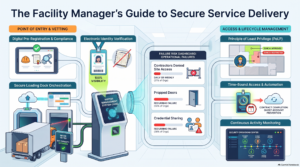
These visitors need enough access to do their jobs—but they should not receive the same level of access as employees. The solution is a clear process that confirms who they are, where they are allowed to go, and how long their access should remain active.
Not Every Visitor Needs the Same Access
A client attending a meeting has very different access needs from an IT contractor working in a server room. Likewise, a delivery driver dropping off a package should not be able to walk freely through an office.
A practical access plan should account for those differences:
| Visitor type | Typical access needed | Recommended approach |
|---|---|---|
| Client or guest | Lobby, meeting room, restroom | Sign-in, visitor badge, and host notification |
| Contractor or service vendor | Assigned work area, equipment room, or loading area | Preapproval, ID verification, temporary access, and an escort when necessary |
| Delivery driver | Reception, loading dock, or designated drop-off point | Recipient confirmation and restricted access |
| Recurring vendor | Specific areas during scheduled service hours | Temporary credentials with defined schedules |
| High-risk service provider | Server rooms, financial offices, records areas, or executive spaces | Restricted access, activity records, and direct supervision |
The goal is simple: give each person access based on the purpose of the visit—not simply because they arrived wearing a uniform or carrying tools.
Know Who Is Coming Before They Arrive
Whenever possible, contractors should be approved before reaching the front desk.
A facilities manager, office manager, project manager, IT representative, or security lead should provide basic information ahead of the visit, including:
- The contractor’s name and company
- The reason for the visit
- The expected arrival time
- The employee responsible for the visit
- The areas where work will take place
- The expected length of the job
- Any equipment or loading access required
- Whether an escort or after-hours access is necessary
This gives reception or security personnel the information they need to verify the visitor quickly. It also reduces delays and eliminates the pressure to make access decisions at the door.
Provide Only the Access They Need
Contractors should receive access to the specific doors, rooms, and areas required for their work—and nothing more.
For example, an AV technician installing a conference-room display may need access to the main entrance, conference room, and nearby telecom closet. That does not mean the technician also needs access to executive offices, storage rooms, HR, or accounting.
A properly configured access-control system can limit access by:
- Door or building area
- Time of day
- Project start and end dates
- Temporary card, fob, or mobile credential
- Automatic expiration
- Recorded access activity
This approach protects the facility without making it harder for contractors to complete their work.
Use Escorts Where They Matter Most
Not every visitor needs an escort. A delivery driver leaving a package at reception may only need a quick check-in. A trusted cleaning company may already have scheduled access under an approved agreement.
Additional supervision is appropriate, however, when someone needs access to:
- Server rooms or IT closets
- Telecom and network rooms
- Financial, HR, or records departments
- Executive offices
- Restricted storage areas
- Areas containing sensitive equipment, customer information, keys, or backup media
An escort is not there to interfere with the work. The escort helps the contractor reach the correct area, answers questions, and makes sure sensitive spaces remain protected.
Create a Consistent Delivery Process
Deliveries can easily become a security gap because they happen frequently and often feel routine.
Drivers should not have to wander through a facility looking for the recipient. Instead, establish a simple and consistent process:
- Use a designated entrance, loading area, reception desk, or delivery point.
- Ask the driver to identify the recipient or department.
- Notify the recipient that the delivery has arrived.
- Keep the driver in the designated area unless additional access is required.
- Record deliveries involving sensitive, valuable, or controlled items.
- Assign an employee to receive or escort deliveries that must go farther into the building.
For a large facility, this may involve a loading dock or secured vestibule. For a smaller office, it may be as simple as requiring all deliveries to remain at reception.
Check Visitors In—and Out
A good visitor-management process should document who entered the facility, why they were there, who approved the visit, and when they left.
The process may include:
- Name and company
- Identification verification when appropriate
- Employee host or contact
- Purpose of the visit
- Arrival time
- Temporary badge or credential
- Approved areas
- Departure time
- Badge or credential return
Temporary credentials should clearly identify the person as a contractor, vendor, or visitor. They should also expire automatically at the end of the approved time or be deactivated during checkout.
This prevents an old badge or mobile credential from remaining active after the work is complete.
Make Someone Responsible for the Process
Technology can support security, but it cannot replace clear responsibility.
Every organization should determine who can approve contractor access, issue temporary credentials, handle exceptions, and review activity when necessary. Depending on the business, that responsibility may belong to facilities, IT, security, reception, a project manager, or a combination of teams.
The important thing is that no one should have to guess whether a visitor belongs in the building or where that person is allowed to go.
A Safer Process Can Still Be a Welcoming One
Managing contractors and deliveries is not about creating unnecessary obstacles. A well-designed process actually makes visits smoother because everyone understands what is expected.
An effective plan should:
- Confirm that the visitor is expected.
- Identify the employee responsible for the visit.
- Limit access to the areas required.
- Record entry and departure.
- Remove access when the work is finished.
When people, procedures, and access-control technology work together, businesses can welcome contractors and deliveries efficiently without creating an unnecessary security risk.
At Avisight, we help businesses design access-control and security solutions that connect their spaces while protecting what matters most.
Connecting spaces, securing what matters.