
Choosing network cable does not have to be complicated. There are two main questions to consider:
- What level of performance does the network need?
- What type of cable jacket is required for the installation area?
Cat 6 or Cat 6A?
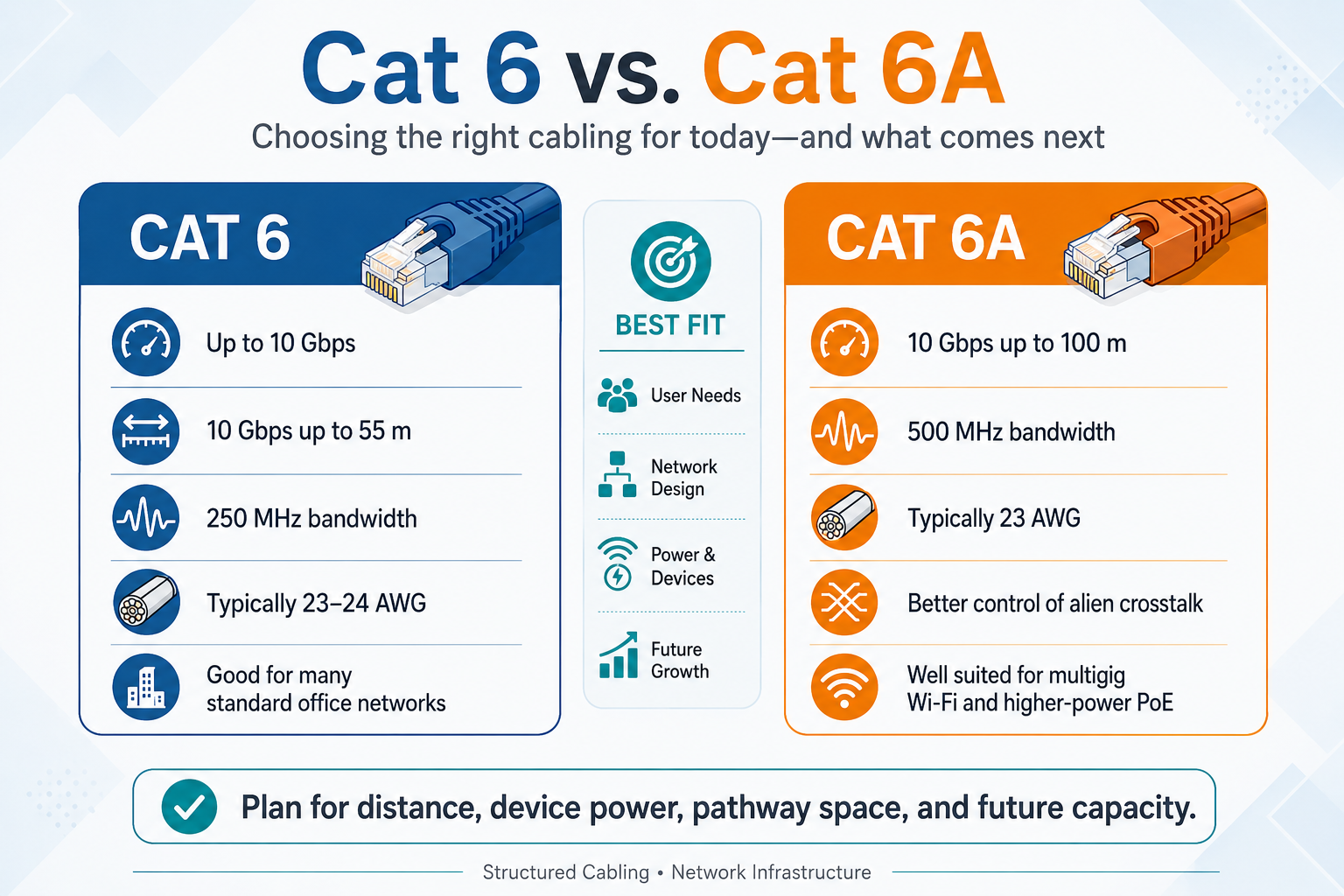
Cat 6 and Cat 6A can both support fast business networks, but they are designed for different situations.
Cat 6
Cat 6 is a practical and affordable choice for many offices.
It provides:
• Up to 1 Gbps at 100 meters
• Up to 10 Gbps on shorter runs, usually no more than 55 meters
• 250 MHz bandwidth
• A thinner and more flexible cable
Cat 6 works well for standard computers, phones, printers, cameras, and many wireless access points.
Cat 6A
Cat 6A is designed for networks that need more speed, power, and capacity.
It provides:
• 10 Gbps at the full 100 meter distance
• 500 MHz bandwidth
• Better protection against interference and crosstalk
• Thicker conductors that can manage heat more effectively
Cat 6A is often a good choice for large offices, data centers, hospitals, Wi Fi 6E and Wi Fi 7 access points, high resolution cameras, and devices using higher levels of Power over Ethernet.
Which one should you choose?
Choose Cat 6 when the cable runs are shorter, the network requirements are standard, and budget is an important factor.
Choose Cat 6A when you need 10 Gbps over longer distances, higher Power over Ethernet capacity, or more room for future growth.
The best cable is not always the most expensive one. It is the cable that fits the needs of the project today and in the future.
Plenum, Riser, and General Purpose Cable
The cable category determines performance. The jacket rating helps determine where the cable can be installed safely.
Local building codes and the Authority Having Jurisdiction should always be reviewed before installation.
CMP Plenum Cable
CMP cable is designed for spaces used to circulate air, such as certain areas above drop ceilings or below raised floors.
It produces less smoke and limits flame spread better than lower rated cable.
CMP cable can normally be used in plenum, riser, and general purpose areas.
CMR Riser Cable
CMR cable is designed for vertical runs between floors.
It helps prevent fire from spreading through riser shafts and floor penetrations.
CMR can normally replace general purpose cable, but it should not be used in a plenum space unless the installation method is specifically approved by the local authority.
CM General Purpose Cable
CM cable is used for general wiring in areas that are not plenums or risers.
It is commonly used for horizontal runs on the same floor and for connecting wall outlets to equipment.
Cable Rating Order
The general rating order is:
- CMP Plenum
- CMR Riser
- CM General Purpose
A higher rated cable can usually replace a lower rated cable. A lower rated cable cannot automatically replace a higher rated cable.
One Cable Type or Several?
Some projects use different cable types for different areas. This can reduce material costs, but it requires careful planning and inventory control.
Other projects use CMP cable throughout the building. This costs more, but it can simplify purchasing and reduce the chance of installing the wrong cable in a plenum area.
The right approach depends on the building, the pathways, the budget, and local code requirements.
Before Installation
Before ordering or installing cable:
- Review the building and mechanical drawings.
- Confirm which ceiling areas are used for return air.
- Identify all vertical runs between floors.
- Check local requirements with the building inspector or Authority Having Jurisdiction.
- Confirm that every cable is properly marked with its category, jacket rating, and certification.
Good network cabling should provide the performance the business needs while also meeting safety and code requirements.
Planning these details before installation can prevent network problems, failed inspections, and expensive replacement work later.