

Securing Your New Commercial Space: A 2026 Guide to Access Control for Business Owners
Moving into a new floor or building is an exciting milestone for any business, but ensuring the physical security of your new space requires careful planning. Today, commercial access control has evolved significantly from the basic deadbolt; it is no longer just about keeping doors locked, but about giving organizations real, integrated control over who enters a space and when.
Relying on traditional mechanical key systems poses a significant security risk because physical keys offer untraceable access and are costly to re-key if lost. If you are planning an office move, here are the essential steps to design a modern, secure, and compliant access control system.
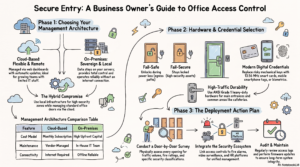
1. Conduct a Comprehensive Door-by-Door Survey
Before selecting any software or hardware, you must evaluate the unique characteristics of every door in your facility. This includes analyzing traffic volume, ADA compliance, and fire codes to ensure you are installing the correct hardware. A critical decision during this phase is choosing between **fail-safe locks**, which unlock during a power loss to allow people to safely exit, and **fail-secure locks**, which remain locked to protect high-value assets during an outage.
2. Identify Your Regulatory and Compliance Needs
Your industry will heavily dictate your security requirements. For example, if your business handles government contracts, you must adhere to guidelines like NIST SP 800-171, which requires you to **enforce physical access authorizations, control visitor activity, and maintain detailed physical access audit logs**. Healthcare facilities must support HIPAA compliance, while industrial sites may need to align with OSHA or CMMC standards. Additionally, if you plan to use biometric access control, you must ensure compliance with privacy laws like the Illinois Biometric Information Privacy Act (BIPA) or the California Consumer Privacy Act (CCPA).
3. Choose Your Architecture: Cloud vs. On-Premises
One of the most consequential choices you will make is where your security data will live.
Cloud-Based Systems: With a cloud system, your infrastructure lives on remote servers managed by a vendor. This model is ideal for growing businesses because it offers **lower upfront costs, effortless scalability, and the ability to manage access remotely from any device
On-Premises Systems: If you operate in a highly regulated industry like finance or defense, an on-premises setup may be mandatory to guarantee **complete data sovereignty and inherent offline reliability. However, these systems require a much higher initial investment and dedicated internal IT staff to manage updates and maintenance.
4. Modernize Your Credentials and Tenant Experience
It is time to move away from vulnerable 125 kHz proximity cards and upgrade to encrypted 13.56 MHz smart cards or mobile access. **Mobile credentials** allow employees to use their smartphones to unlock doors via Bluetooth or NFC. This not only provides a premium, touchless entry experience, but it also significantly increases security since smartphones are typically locked by the user. Furthermore, mobile credentials can integrate with tenant experience apps that act as electronic guidebooks for your building’s amenities.
5. Prioritize Deep System Integration
Modern access control systems should never operate in a silo. To get the best return on your investment, ensure your access control platform integrates seamlessly with video surveillance, visitor management software, human resources platforms, and intrusion detection systems. A unified system allows your team to monitor access events and video feeds simultaneously on a single dashboard, vastly improving your ability to investigate incidents and enforce security policies.
6. Factor in Lifecycle Maintenance and Documentation
Finally, understand that an access control system is a network device that requires ongoing upkeep. Your system will require robust cybersecurity measures, including VLAN segmentation and regular firmware updates. To protect your investment, **demand comprehensive closeout documentation from your installer**, including wiring diagrams, hardware schedules, and equipment location drawings. This documentation is the benchmark of a quality installation and is vital for future serviceability.
By treating your access control system as an integrated piece of your broader business technology environment, you can close security gaps, ensure regulatory compliance, and create a safer, more efficient space for your team.